
$280.00
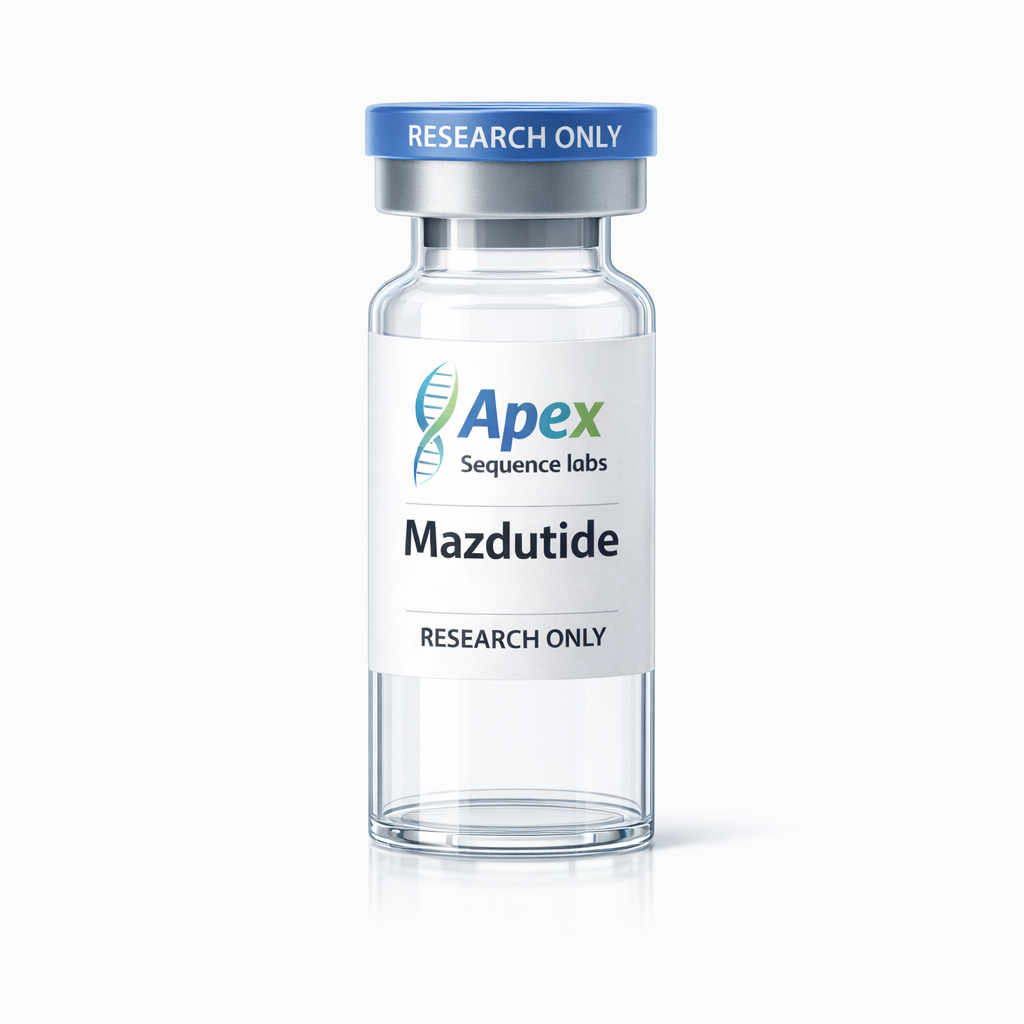
Mazdutide Apex Sequence Labs GLP-1/Glucagon Dual Receptor Agonist Peptide | Research Peptide – pack of 10
120 in stock
Overview
Mazdutide (IBI362, OXM3) is a synthetic, long-acting dual receptor agonist peptide that simultaneously targets both the Glucagon-like Peptide-1 (GLP-1) receptor and the Glucagon (GCGR) receptor. Developed by Innovent Biologics as part of the next generation of incretin-based metabolic research compounds, Mazdutide represents a structurally distinct and scientifically compelling alternative to GLP-1 single agonists and GIP/GLP-1 dual agonists, incorporating glucagon receptor co-activation as its defining pharmacological feature. By combining GLP-1 receptor-mediated insulinotropic and appetite-suppressing effects with glucagon receptor-mediated enhancement of energy expenditure, hepatic fat metabolism, and thermogenesis, Mazdutide offers researchers a uniquely differentiated tool for investigating the synergistic metabolic consequences of simultaneous GLP-1 and glucagon receptor engagement. Apex Sequence Labs offers Mazdutide at the highest purity standards, rigorously tested and manufactured under strict quality control protocols to ensure consistency and reliability for cutting-edge scientific research.
Molecular Profile
Full Name: Mazdutide (IBI362 / OXM3)
Type: Dual GLP-1/Glucagon Receptor Agonist
Structural Basis: Oxyntomodulin-derived sequence with optimised modifications
Molecular Formula: C???H???N??O??S
Molecular Weight: ~3590.9 g/mol
CAS Number: 2413928-16-0
Purity: 99% (HPLC verified)
Form: Lyophilized powder
Half-Life: Approximately 7 days (designed for once-weekly dosing in research models)
Structural Origin: Optimised analogue of native oxyntomodulin (OXM)
Research Areas of Interest
Mazdutide has rapidly emerged as one of the most scientifically compelling next-generation metabolic peptides under active investigation, with a research profile that spans metabolic science, hepatology, cardiovascular research, and endocrinology:
Metabolic Research & Energy Homeostasis The defining feature of Mazdutide’s research profile is its dual engagement of both GLP-1 and glucagon receptors, enabling researchers to study the complementary and synergistic metabolic effects of simultaneous incretin and glucagon pathway co-activation. Research has explored how this dual receptor engagement influences total energy expenditure, basal metabolic rate, substrate utilisation, and overall metabolic flexibility in preclinical and clinical research models, with glucagon receptor co-activation providing a distinctive energy expenditure-enhancing dimension not present in GLP-1 single agonists or GIP/GLP-1 dual agonists.
Body Composition & Obesity Research Among the most intensely studied applications of Mazdutide, research has documented significant effects on body weight reduction and fat mass across preclinical and clinical study populations. The combination of GLP-1 receptor-mediated appetite suppression and glucagon receptor-mediated enhancement of lipolysis and energy expenditure has been proposed to produce an additive or synergistic effect on fat mass reduction, with particular research interest in the differential effects on visceral versus subcutaneous adipose compartments and the preservation of lean muscle mass during weight reduction.
Glucose Metabolism & Glycaemic Control Research Investigated for its effects on insulin secretion, glucose-dependent insulinotropic activity, and overall glycaemic control through GLP-1 receptor activation. Research has explored how the glucagon receptor component of Mazdutide’s dual agonism which might theoretically raise glucose through hepatic glucose output is balanced or overridden by its GLP-1-mediated insulinotropic effects in the context of fed versus fasted metabolic states, providing researchers with a nuanced model for studying the complex interplay between incretin and glucagon signalling in glucose homeostasis.
Hepatic Metabolism & Liver Disease Research One of the most scientifically distinctive aspects of Mazdutide research is its potential for addressing hepatic metabolic dysfunction. Glucagon receptor activation is known to stimulate hepatic fat oxidation and reduce hepatic lipid accumulation through mechanisms distinct from GLP-1 receptor-mediated pathways, making Mazdutide a particularly valuable research tool for studying the hepatic effects of dual GLP-1/glucagon receptor engagement. Studies have explored its effects on hepatic steatosis, liver enzyme normalisation, and histological markers of NAFLD and NASH, with early research suggesting potentially superior hepatic efficacy compared to GLP-1 single agonists.
Cardiovascular Research Investigated for its potential cardioprotective and cardiometabolic effects, including improvements in lipid profiles, reductions in triglycerides, modulation of inflammatory cardiovascular risk markers, and effects on blood pressure regulation in metabolic disease models. Research has also explored the cardiovascular implications of glucagon receptor co-activation, including its effects on cardiac function, heart rate, and the balance between GLP-1 mediated cardioprotection and glucagon-mediated cardiac stimulation.
Thermogenesis & Brown Adipose Tissue Research A scientifically distinctive area of Mazdutide investigation, glucagon receptor activation has been associated with stimulation of brown adipose tissue (BAT) thermogenesis and increased uncoupling protein 1 (UCP1) expression in preclinical models. Research has explored how Mazdutide’s glucagon receptor component may contribute to enhanced energy expenditure through BAT activation and thermogenic upregulation, a mechanism that distinguishes it from GLP-1 single agonists and may contribute to its metabolic efficacy profile.
Appetite & Satiety Neurobiology Research Studied for its central and peripheral effects on appetite regulation, including modulation of hypothalamic hunger signalling, gastric emptying, and satiety hormone release through GLP-1 receptor activation. Research has explored how the dual receptor profile of Mazdutide influences the overall appetite-suppressing phenotype relative to GLP-1 single agonists, and whether glucagon receptor co-activation modifies or enhances the central appetite-suppressing effects mediated through the GLP-1 pathway.
Oxyntomodulin Biology Research As an optimised analogue of native oxyntomodulin a naturally occurring gut hormone that itself acts as a dual GLP-1/glucagon receptor agonist Mazdutide provides researchers with a highly potent and pharmacokinetically optimised tool for studying the biology of oxyntomodulin receptor signalling. Research has explored the physiological roles of endogenous oxyntomodulin in postprandial metabolism, energy homeostasis, and the regulation of food intake, with Mazdutide serving as a valuable pharmacological probe for dissecting OXM receptor pharmacology.
Renal Research Emerging research has begun exploring the nephroprotective potential of GLP-1/glucagon dual agonism, with studies examining Mazdutide’s effects on renal function markers, albuminuria, and glomerular filtration in metabolic disease models, building on the established nephroprotective evidence base for GLP-1 receptor agonists while investigating the additional contribution of glucagon receptor co-activation to renal outcomes.
Comparative Metabolic Research As the metabolic peptide research landscape has expanded to encompass GLP-1 single agonists, GIP/GLP-1 dual agonists, and GIP/GLP-1/glucagon triple agonists, Mazdutide’s unique GLP-1/glucagon dual agonist profile positions it as a critical comparator compound for studying the differential metabolic contributions of GIP versus glucagon receptor co-activation alongside GLP-1. Research utilising Mazdutide alongside Tirzepatide and Retatrutide enables systematic dissection of the individual receptor contributions to metabolic outcomes across the incretin and glucagon receptor pharmacology landscape.
What Sets Mazdutide Apart?
Mazdutide’s scientific distinctiveness stems from its unique pharmacological profile and structural origin:
GLP-1/Glucagon Dual Agonism Unlike Tirzepatide’s GIP/GLP-1 mechanism, Mazdutide’s pairing of GLP-1 with glucagon receptor co-activation introduces a fundamentally different second receptor pathway, enabling researchers to directly compare the metabolic consequences of GIP versus glucagon co-activation alongside GLP-1 in controlled experimental settings
Oxyntomodulin-Derived Structure As an optimised analogue of native oxyntomodulin, Mazdutide provides researchers with a pharmacologically enhanced tool for studying OXM biology, with structural optimisations conferring dramatically improved potency, selectivity, and pharmacokinetic stability compared to the native hormone
Glucagon-Mediated Hepatic Fat Oxidation The glucagon receptor component of Mazdutide’s dual agonism introduces a direct hepatic fat-burning mechanism through stimulation of hepatic fatty acid oxidation and ketogenesis pathways, potentially offering superior hepatic efficacy for NAFLD/NASH research compared to incretin-only compounds
Enhanced Thermogenesis Research Utility The glucagon receptor-mediated BAT activation and thermogenic enhancement associated with Mazdutide provides a unique research dimension for studying non-shivering thermogenesis and energy expenditure that is not accessible through GLP-1 or GIP receptor agonism alone
Critical Comparator in Multi-Agonist Research In an era of rapidly expanding incretin pharmacology research, Mazdutide’s GLP-1/GCGR profile makes it an indispensable comparator compound for researchers seeking to systematically dissect the individual and combined contributions of GIP, GLP-1, and glucagon receptors to metabolic regulation
Once-Weekly Pharmacokinetic Profile Structural optimisations from the native oxyntomodulin sequence confer an extended half-life enabling once-weekly research dosing protocols, significantly enhancing the practical utility of Mazdutide in longitudinal metabolic research studies
Quality Assurance
All Apex Sequence Labs peptides are:
Synthesized using advanced solid-phase peptide synthesis (SPPS)
Third-party tested via HPLC and Mass Spectrometry
Produced in a controlled, sterile, ISO-compliant laboratory environment
Supplied with a Certificate of Analysis (CoA) available upon request
Packaging & Storage
Available in: 2mg | 5mg | 10mg vials
Storage: Store lyophilized peptide at ?20°C away from light and moisture
Once reconstituted: Store at 4°C and use within 28 days
Recommended diluent: Bacteriostatic water or sterile water for injection
Shelf life: 24 months when stored correctly in lyophilized form
Why Choose Apex Sequence Labs?
– ?99% purity guaranteed
– Independent third-party testing on every batch
– Certificate of Analysis provided
– Produced in ISO-compliant cleanroom facilities
– Fast, discreet shipping
– Dedicated researcher support team
– Research Use Only Disclaimer
Mazdutide supplied by Apex Sequence Labs is intended strictly for in vitro and in vivo laboratory research purposes only. This product is NOT intended for human or veterinary use, is NOT a drug or dietary supplement, and has NOT been evaluated or approved by the FDA or any other regulatory authority for therapeutic, diagnostic, or prophylactic use. Mazdutide is an investigational compound currently undergoing clinical evaluation and is not approved for any clinical or consumer application. By purchasing this product, the buyer confirms they are a qualified researcher and accepts full responsibility for its lawful and ethical use in accordance with all applicable local, state, and federal regulations.
| Dosage | 10mg |
|---|


Reviews
There are no reviews yet.