£760 – £1,074Price range: £760 through £1,074
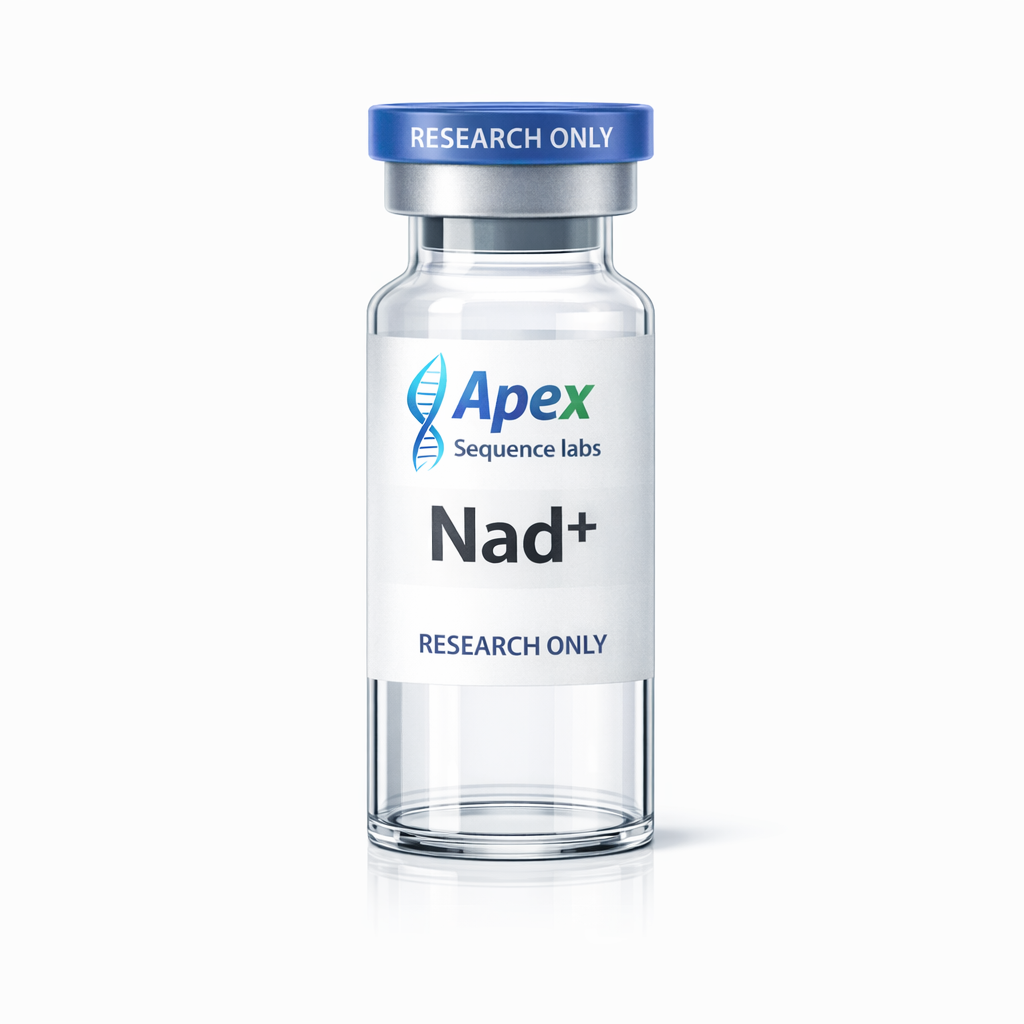
NAD+ | Apex Sequence Labs
Nicotinamide Adenine Dinucleotide | Coenzyme Research Compound
NAD+ Apex Sequence Labs
Nicotinamide Adenine Dinucleotide | Coenzyme Research Compound
Overview
Nicotinamide Adenine Dinucleotide (NAD+) is one of the most fundamental and ubiquitous coenzymes in cellular biology, present in every living cell and essential to hundreds of metabolic reactions that sustain life. As a critical mediator of cellular energy metabolism, DNA repair, gene expression regulation, and circadian rhythm maintenance, NAD+ has emerged as one of the most intensely researched molecules in contemporary biomedical science. Its central role in the biology of ageing, mitochondrial function, and cellular stress response has positioned it at the forefront of longevity research, metabolic science, and neuroscience. Apex Sequence Labs offers NAD+ at the highest purity standards, rigorously tested and manufactured under strict quality control protocols to ensure consistency and reliability for advanced scientific investigation.
Molecular Profile
Full Name: Nicotinamide Adenine Dinucleotide (oxidised form)
Abbreviation: NAD+
Molecular Formula: C??H??N?O??P?
Molecular Weight: 663.43 g/mol
CAS Number: 53-84-9
Purity: ?99% (HPLC verified)
Form: Lyophilized powder
Appearance: White to off-white powder
Solubility: Soluble in water
Research Areas of Interest
NAD+ occupies a uniquely central position in cellular biology, and its research applications span virtually every major discipline in biomedical science:
Cellular Energy Metabolism & Mitochondrial Research As an essential electron carrier in the mitochondrial electron transport chain, NAD+ plays an indispensable role in oxidative phosphorylation and ATP synthesis. Research has extensively investigated the relationship between cellular NAD+ levels, mitochondrial biogenesis, and metabolic efficiency, with declining NAD+ concentrations consistently observed in aged tissues and metabolic disease states. Studies using NAD+ supplementation in preclinical models have explored its capacity to restore mitochondrial function and improve cellular energy status.
Ageing & Longevity Research Perhaps the most compelling and rapidly expanding frontier of NAD+ science, research has established a robust association between age-related NAD+ decline and the hallmarks of biological ageing. Studies have explored NAD+’s role in activating sirtuins (SIRT1-7) a family of NAD+-dependent deacylases central to longevity signalling and its relationship with AMPK activation, mTOR inhibition, and other key longevity pathways. Preclinical research in multiple model organisms has demonstrated lifespan extension and healthspan improvements associated with NAD+ restoration.
DNA Repair & Genomic Stability Research NAD+ serves as the essential substrate for Poly(ADP-ribose) polymerases (PARPs), a family of enzymes critical to the detection and repair of DNA strand breaks. Research has extensively studied the relationship between NAD+ availability, PARP activity, and the efficiency of the DNA damage response, with implications for understanding cancer biology, radiation resistance, and age-related genomic instability.
Sirtuin Activation Research As the obligate co-substrate for all seven mammalian sirtuins, NAD+ is indispensable to sirtuin-mediated regulation of metabolism, stress resistance, inflammation, and longevity. Research has explored how NAD+ levels gate sirtuin activity across different tissues and cellular compartments, and how this relationship influences metabolic homeostasis, mitochondrial quality control, and epigenetic regulation.
Neurological & Neuroprotective Research NAD+ has attracted substantial scientific interest for its neuroprotective properties and its role in neuronal energy metabolism, axonal integrity, and synaptic function. Research has explored its potential relevance to neurodegenerative conditions including Alzheimer’s disease, Parkinson’s disease, and amyotrophic lateral sclerosis (ALS), with preclinical studies investigating NAD+ restoration as a strategy to attenuate neuroinflammation, oxidative stress, and neuronal apoptosis.
Metabolic & Insulin Sensitivity Research Investigated for its effects on glucose homeostasis, insulin sensitivity, and lipid metabolism across multiple tissues, NAD+ research has explored its capacity to improve metabolic flexibility, enhance fatty acid oxidation, and attenuate features of metabolic syndrome in preclinical models. Its relationship with SIRT1 and SIRT3 activation in liver, muscle, and adipose tissue has been a particular focus of metabolic NAD+ research.
Cardiovascular Research Studied for its cardioprotective properties, including its role in protecting cardiomyocytes from ischaemic injury, reducing oxidative stress in vascular tissue, and modulating inflammatory pathways associated with atherosclerosis and heart failure. Research has explored NAD+ restoration as a potential strategy to improve cardiac energetics and attenuate age-related cardiac dysfunction.
Immunological & Inflammation Research Investigated for its role in regulating innate and adaptive immune function, including modulation of macrophage polarisation, T cell metabolism, and pro-inflammatory cytokine production. Research has explored the relationship between NAD+ levels and inflammatory signalling pathways, including NF-?B and NLRP3 inflammasome activation, with implications for understanding chronic inflammatory disease.
Circadian Rhythm & Sleep Research NAD+ occupies a central position in the molecular clockwork of circadian biology, serving as a critical link between cellular metabolism and circadian oscillator function through its relationship with SIRT1, CLOCK, and NAMPT-mediated biosynthesis. Research has explored how NAD+ fluctuations across the circadian cycle influence metabolic gene expression, mitochondrial dynamics, and sleep-wake regulation.
Cancer Biology Research Investigated across multiple dimensions of oncology research, including its role as a PARP substrate in DNA damage repair pathways relevant to cancer cell survival, its relationship with NAD+-consuming enzymes such as CD38 and SARM1, and the potential of NAD+ metabolism as a therapeutic target in cancer biology. Research has also explored the differential NAD+ requirements of cancer versus normal cells as a potential basis for selective targeting strategies.
Muscle & Exercise Biology Research Studied for its effects on skeletal muscle metabolism, exercise adaptation, and age-related sarcopenia, with research exploring how NAD+ availability influences mitochondrial biogenesis in muscle tissue, fatigue resistance, and the molecular response to endurance exercise through SIRT1 and PGC-1? activation.
The NAD+ Biosynthesis & Salvage Pathway
Understanding NAD+ research requires familiarity with its major biosynthetic routes, which are themselves active areas of scientific investigation:
Salvage Pathway The predominant route of NAD+ synthesis in mammalian cells, proceeding from nicotinamide (Nam) through NAMPT-catalysed conversion to NMN, then to NAD+ via NMNAT enzymes
Preiss-Handler Pathway Synthesis from nicotinic acid (niacin) via NAPRT, NaMN, and NADS enzymes
De Novo Pathway Synthesis from tryptophan through the kynurenine pathway, culminating in quinolinic acid conversion to NAD+
NR/NMN Supplementation Research Extensive research has explored nicotinamide riboside (NR) and nicotinamide mononucleotide (NMN) as NAD+ precursors, with studies examining their relative efficacy as research tools for elevating cellular and tissue NAD+ levels across different experimental contexts
Quality Assurance
All Apex Sequence Labs research compounds are:
Produced using validated synthesis and purification protocols
Third-party tested via HPLC and Mass Spectrometry
Tested for heavy metals, residual solvents, and endotoxins
Produced in a controlled, sterile, ISO-compliant laboratory environment
Supplied with a Certificate of Analysis (CoA) available upon request
Packaging & Storage
Available in: 100mg | 500mg | 1000mg vials
Storage: Store at 20°C, protected from light and moisture
Stability: NAD+ is hygroscopic and sensitive to heat and light handle under inert atmosphere where possible
Recommended diluent: Sterile water for injection or PBS (phosphate-buffered saline)
Shelf life: 24 months when stored correctly in lyophilized form
Note: Avoid repeated freeze-thaw cycles to preserve compound integrity
Why Choose Apex Sequence Labs?
– 99% purity guaranteed
– Independent third-party testing on every batch
– Certificate of Analysis provided
– Heavy metal & endotoxin tested
– Produced in ISO-compliant cleanroom facilities
– Fast, discreet shipping
– Dedicated researcher support team
– Research Use Only Disclaimer
NAD+ (Nicotinamide Adenine Dinucleotide) supplied by Apex Sequence Labs is intended strictly for in vitro and in vivo laboratory research purposes only. This product is NOT intended for human or veterinary use, is NOT a drug or dietary supplement, and has NOT been evaluated or approved by the FDA or any other regulatory authority for therapeutic, diagnostic, or prophylactic use. By purchasing this product, the buyer confirms they are a qualified researcher and accepts full responsibility for its lawful and ethical use in accordance with all applicable local, state, and federal regulations.
| Dosage | 1000mg, 100mg, 500mg |
|---|
Reviews
There are no reviews yet.