
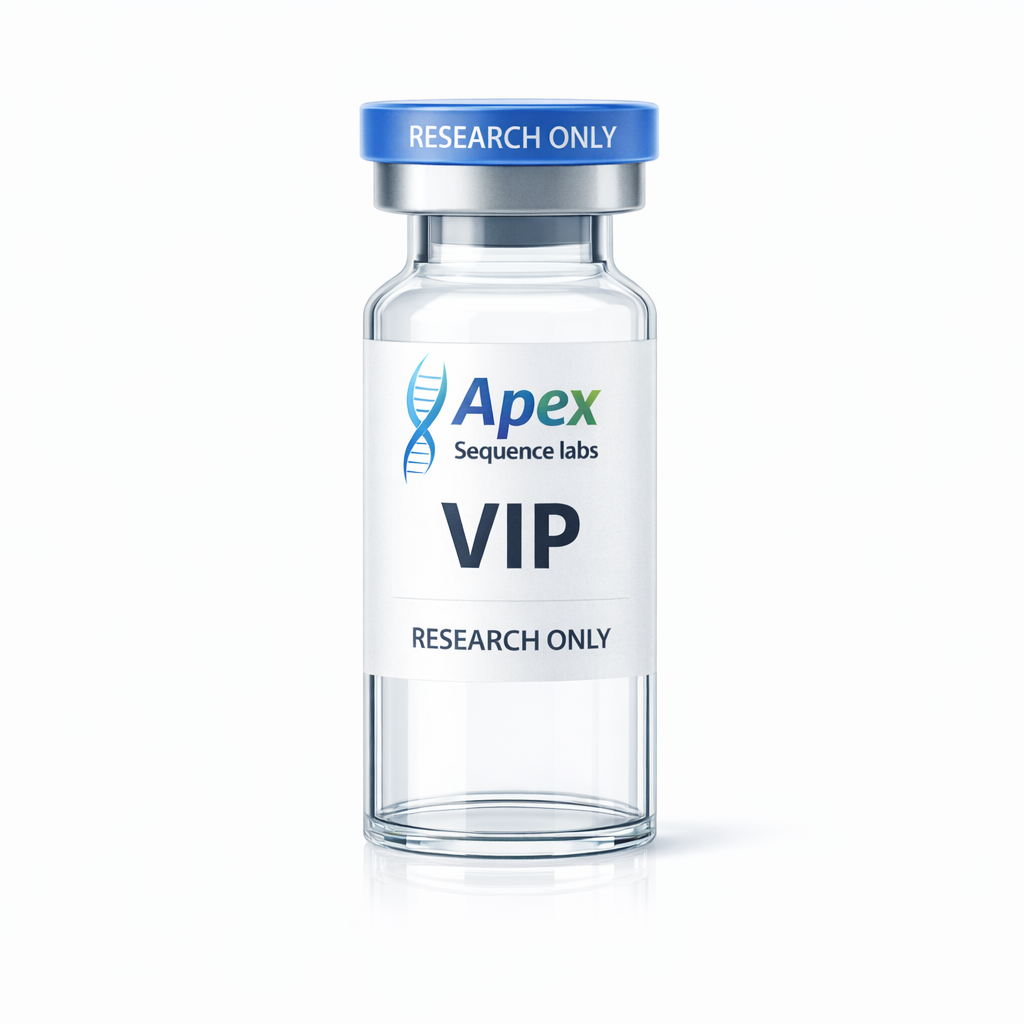
$69 – $123Price range: $69 through $123
VIP (Vasoactive Intestinal Peptide)| 10 vials| Apex Sequence Labs
Neuropeptide & Immunomodulatory Research Compound | 28 Amino Acid Peptide – Pack of 10
Overview
Vasoactive Intestinal Peptide (VIP) is a naturally occurring 28 amino acid neuropeptide belonging to the secretin/glucagon superfamily of peptides, endogenously expressed throughout the central and peripheral nervous systems, gastrointestinal tract, lungs, and immune tissues. First isolated in 1970 from porcine intestinal tissue by Said and Mutt, VIP has since emerged as one of the most pleiotropic and scientifically fascinating signalling molecules in mammalian biology. Acting primarily through the VPAC1 and VPAC2 G-protein coupled receptors, VIP orchestrates an extraordinarily diverse range of physiological processes spanning neurotransmission, immune regulation, smooth muscle relaxation, circadian rhythm entrainment, and cellular survival. Its remarkable breadth of biological activity has made it a subject of intense and growing scientific investigation across neuroscience, immunology, pulmonology, gastroenterology, and circadian biology research. Apex Sequence Labs offers VIP at the highest purity standards, rigorously tested and manufactured under strict quality control protocols to ensure consistency and reliability for advanced scientific investigation.
Molecular Profile
Full Name: Vasoactive Intestinal Peptide
Abbreviation: VIP
Sequence: His-Ser-Asp-Ala-Val-Phe-Thr-Asp-Asn-Tyr-Thr-Arg-Leu-Arg-Lys-Gln-Met-Ala-Val-Lys-Lys-Tyr-Leu-Asn-Ser-Ile-Leu-Asn-NH?
Molecular Formula: C???H???N??O??S
Molecular Weight: 3326.8 g/mol
CAS Number: 37221-79-7
Purity: 99% (HPLC verified)
Form: Lyophilized powder
Appearance: White to off-white powder
Receptors: VPAC1 (VIPR1), VPAC2 (VIPR2), PAC1
Research Areas of Interest
VIP’s extraordinary biological versatility has made it a research compound of interest across an exceptionally wide range of scientific disciplines:
Immunomodulatory & Anti-Inflammatory Research Among the most extensively studied properties of VIP is its potent immunomodulatory activity. Research has documented VIP’s capacity to shift immune responses from pro-inflammatory to regulatory and tolerogenic states through multiple mechanisms, including suppression of TNF-?, IL-6, IL-12, and IL-18 production, upregulation of IL-10 and TGF-?, promotion of regulatory T cell (Treg) differentiation, and inhibition of dendritic cell maturation. Studies have explored VIP’s potential relevance to autoimmune disease models, transplant tolerance research, and chronic inflammatory disease, positioning it as one of the most potent endogenous anti-inflammatory neuropeptides identified to date.
Neuroscience & Neuroprotective Research As a widely distributed neuropeptide in both the central and peripheral nervous systems, VIP has been extensively studied for its neuromodulatory, neuroprotective, and neurotrophic properties. Research has explored its role in modulating synaptic transmission, promoting neuronal survival under conditions of oxidative stress and excitotoxicity, stimulating neurotrophic factor release, and regulating neuroinflammation through glial cell modulation. Studies have investigated its potential relevance to neurodegenerative disease models including Alzheimer’s disease, Parkinson’s disease, and multiple sclerosis research.
Circadian Biology & Sleep Research VIP occupies a uniquely central position in circadian biology as the primary synchronising neuropeptide of the suprachiasmatic nucleus (SCN), the brain’s master circadian clock. Research has extensively studied VIP’s role in coordinating the synchronisation of individual SCN neurons into coherent population-level circadian oscillations, its involvement in light-entrainment of the circadian clock, and its relationship with downstream circadian outputs governing sleep-wake cycles, hormonal rhythms, and metabolic timing. VIP-deficient animal models have been instrumental in elucidating the mechanisms of circadian rhythm generation and entrainment.
Pulmonary & Respiratory Research Extensively studied in the context of pulmonary biology, VIP has been investigated for its potent bronchodilatory properties, anti-inflammatory effects in airway tissue, modulation of pulmonary vascular tone, and protective effects in models of pulmonary hypertension, asthma, and acute lung injury. Research has explored VIP’s interactions with airway smooth muscle, pulmonary endothelium, and resident immune cells of the lung, contributing to a growing body of evidence on neuropeptide-mediated regulation of pulmonary function.
Gastrointestinal Research Given its original discovery in intestinal tissue, the gastrointestinal system remains a primary site of VIP research. Studies have investigated its role as an inhibitory neurotransmitter in the enteric nervous system, its effects on intestinal smooth muscle relaxation, regulation of intestinal secretion and absorption, mucosal immune modulation, and its potential relevance to inflammatory bowel disease (IBD), irritable bowel syndrome (IBS), and gut barrier integrity research.
Cardiovascular Research Studied extensively for its potent vasodilatory properties and cardioprotective effects, VIP has been investigated for its role in regulating vascular smooth muscle tone, improving coronary blood flow, reducing cardiac afterload, and protecting cardiomyocytes from ischaemic injury. Research has also explored its effects on pulmonary arterial hypertension (PAH) models, cardiac arrhythmia regulation, and myocardial function in heart failure models.
Reproductive & Endocrinological Research Investigated for its diverse roles in reproductive biology, including modulation of gonadotropin releasing hormone (GnRH) signalling, regulation of prolactin secretion, influence on uterine contractility, and effects on sperm motility and fertilisation in preclinical models. Research has also explored VIP’s broader endocrinological roles in growth hormone regulation, thyroid function, and adrenal cortex modulation.
Oncology & Cell Survival Research Studied for its anti-apoptotic and pro-survival signalling properties in multiple cell types, with research exploring VIP receptor expression patterns in various tumour types, its role in modulating tumour microenvironment inflammation, and its potential as a research tool for studying VPAC receptor-mediated survival pathways in both normal and malignant cell biology.
Ocular Research An emerging area of VIP investigation, studies have explored its neuroprotective effects on retinal ganglion cells, its role in regulating intraocular pressure, and its potential relevance to glaucoma and retinal degeneration research models, contributing to growing scientific interest in neuropeptide-mediated ocular biology.
Wound Healing & Tissue Repair Research Investigated for its pro-angiogenic properties, modulation of fibroblast activity, and effects on tissue remodelling processes, with studies exploring VIP’s potential role in accelerating wound closure, reducing scar formation, and promoting vascular regeneration in preclinical wound healing models.
VIP Receptor Pharmacology
A key aspect of VIP research involves its interactions with three known receptor subtypes, each with distinct tissue distributions and signalling profiles:
VPAC1 (VIPR1) Widely expressed in the lung, liver, intestine, T lymphocytes, and brain; mediates many of VIP’s anti-inflammatory and gastrointestinal effects through Gs-coupled adenylyl cyclase activation and cAMP elevation
VPAC2 (VIPR2) Predominantly expressed in the suprachiasmatic nucleus, pancreas, uterus, skeletal muscle, and heart; plays a central role in circadian rhythm synchronisation and pancreatic hormone regulation
PAC1 Primarily a PACAP receptor with lower affinity for VIP; expressed in the brain, adrenal medulla, and reproductive tissues; mediates overlapping neuroendocrine effects shared between VIP and PACAP
What Sets VIP Apart?
Pleiotropic Multi-System Activity Few endogenous peptides match VIP’s breadth of biological activity across neurological, immunological, pulmonary, gastrointestinal, cardiovascular, and reproductive systems, making it an exceptionally versatile multi-disciplinary research tool
Master Circadian Synchroniser VIP’s unique role as the primary neuropeptide synchroniser of the SCN master clock makes it irreplaceable as a research tool in circadian biology, with no other endogenous molecule playing an equivalent role in circadian network coordination
Endogenous Anti-Inflammatory Neuropeptide As one of the most potent endogenous anti-inflammatory signalling molecules identified, VIP represents a uniquely valuable research tool for studying neuropeptide-immune system crosstalk and neuroinflammatory regulation
Dual Nervous System & Immune System Role VIP’s co-expression in both neural and immune tissues positions it at the intersection of neuroimmunology, one of the most rapidly growing fields in contemporary biomedical research
Well-Characterised Receptor Pharmacology The availability of selective VPAC1, VPAC2, and PAC1 agonists and antagonists provides researchers with a well-developed pharmacological toolkit for dissecting VIP’s receptor-specific effects across different tissue and cellular contexts
Quality Assurance
All Apex Sequence Labs peptides are:
Synthesized using advanced solid-phase peptide synthesis (SPPS)
C-terminal amidation verified through analytical testing
Third-party tested via HPLC and Mass Spectrometry
Produced in a controlled, sterile, ISO-compliant laboratory environment
Supplied with a Certificate of Analysis (CoA) available upon request
Packaging & Storage
Available in: 1mg | 5mg | 10mg vials
Storage: Store lyophilized peptide at ?20°C away from light and moisture
Once reconstituted: Store at 4°C and use within 14 days
Recommended diluent: Sterile water for injection or sterile PBS
Shelf life: 24 months when stored correctly in lyophilized form
Note: VIP is particularly sensitive to repeated freeze-thaw cycles; aliquot prior to reconstitution where possible
Why Choose Apex Sequence Labs?
– 99% purity guaranteed
– Independent third-party testing on every batch
– Certificate of Analysis provided
– C-terminal amidation analytically verified
– Produced in ISO-compliant cleanroom facilities
– Fast, discreet shipping
– Dedicated researcher support team
– Research Use Only Disclaimer
Vasoactive Intestinal Peptide (VIP) supplied by Apex Sequence Labs is intended strictly for in vitro and in vivo laboratory research purposes only. This product is NOT intended for human or veterinary use, is NOT a drug or dietary supplement, and has NOT been evaluated or approved by the FDA or any other regulatory authority for therapeutic, diagnostic, or prophylactic use. By purchasing this product, the buyer confirms they are a qualified researcher and accepts full responsibility for its lawful and ethical use in accordance with all applicable local, state, and federal regulations.
Apex Sequence Labs Precision. Purity. Progress.
| Dosage | 10mg, 5mg |
|---|

Reviews
There are no reviews yet.